TL;DR
Most "best AI for SOX" listicles mix four different layers of the stack, which makes them useless to a buyer. Only five vendors actually operate in the issuer-side AI testing and workpaper automation layer end to end. Arden, AuditBoard, Workiva, Fieldguide, and MindBridge. The rest sit beneath that layer in GRC systems of record, evidence collection, or access governance, and selecting them on the assumption they are equivalent is the most common procurement mistake under SOX 404(a).
There is a category problem in SOX automation right now. Every vendor in adjacent categories has shipped an AI feature, and every "best AI for SOX" listicle treats them as comparable. They are not.
Most of the companies that show up in those lists are GRC systems of record, evidence collection tools, or access governance platforms. They do important work. They are not AI testing automation, and pretending otherwise wastes the buyer's time.
This piece defines the testing and workpaper automation layer narrowly, lists the five companies actually playing in it, and explains why several you might expect to see here belong in a different layer.
Bias disclosure. Arden is on this list. The author runs Arden. The descriptions below are written to be useful to a SOX PMO evaluating the layer, not to favor Arden over alternatives. Where Arden's positioning differs from competitors, that is stated explicitly.

The four layers of SOX automation
Before naming companies, define the layers. Most procurement confusion in this market is about layer mismatch.
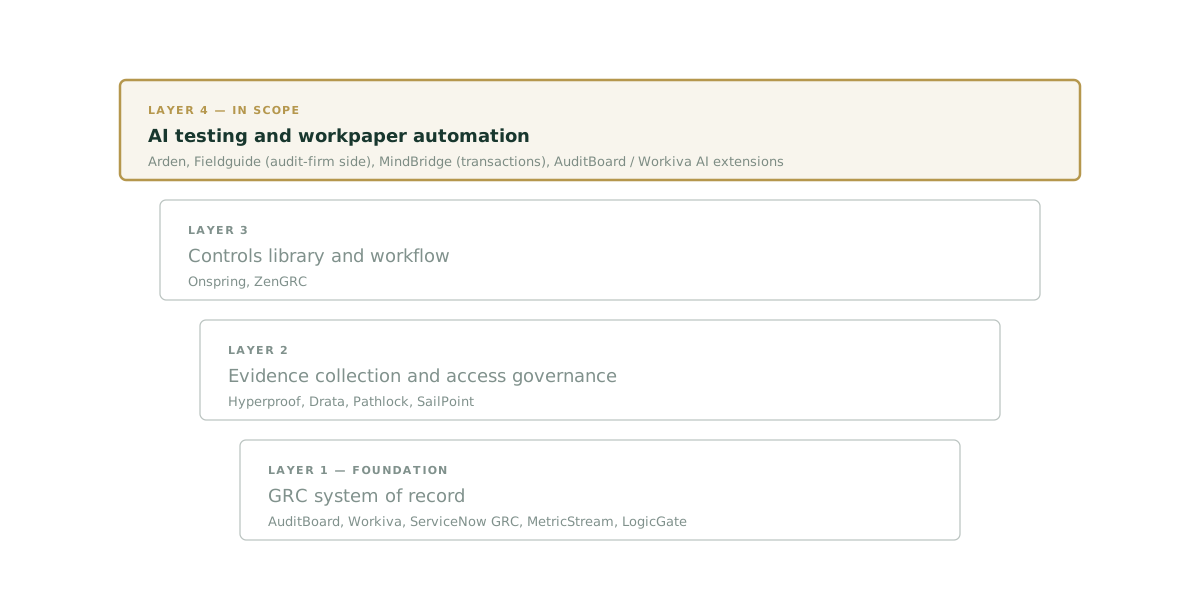
| Layer | What it does | Common buyers |
|---|---|---|
| GRC system of record | Control inventory, control owners, certification cycles, issue tracking, audit management | SOX PMO, internal audit |
| Evidence collection and access governance | Pulls screenshots, exports, tickets, logs. Manages user access reviews, role conflicts, segregation of duties | Compliance ops, IT GRC |
| Controls library and workflow | Houses control descriptions, narratives, walkthroughs, and routing | SOX PMO, process owners |
| AI testing and workpaper automation | Executes tests, drafts exception write-ups, produces workpapers with evidence lineage and reviewer evidence | SOX PMO, controllership, internal audit |
The five companies below operate in the top layer, with varying degrees of overlap into the others. This piece focuses on the testing and workpaper automation work itself, not the breadth of the platform.
How the layer is defined
A vendor in the AI testing and workpaper automation layer should be able to do all four of the following on a single SOX control test, end to end, without requiring a human to assemble the workpaper from outputs across systems.
- Pull the source population from the system of record.
- Apply the control's procedure to each item in the population, with rule logic the reviewer can challenge.
- Identify deviations and draft an exception write-up using the audit taxonomy (deviation, control deficiency, etc., with severity left to the evaluator under the AS 2201.A3-A7 framework).
- Produce a workpaper containing evidence lineage, reviewer evidence capture, and a reproducibility log.
Vendors that do part of this and rely on integrations to fill in the rest are real and useful. They are not in this layer for the purposes of this piece.

The five companies
1. Arden
Layer fit. AI testing and workpaper automation, issuer-side. Best for. Public and pre-IPO companies running SOX 404(a) programs in-house, with an emphasis on ITGC testing. Differentiation. Built around the management review control problem. Workpapers ship with explicit evidence lineage, reviewer evidence capture, and reproducibility logs. The explicit position is that agents extend the preparer's reach but do not supply the evaluator's judgment that 33-8810 requires. What it is not. Arden is not a GRC system of record. Customers usually keep their AuditBoard or Workiva instance and use Arden for the testing and workpaper layer.
2. AuditBoard
Layer fit. Primarily a GRC system of record. AI extensions reach into the testing layer for specific control types. Best for. Mid-market and enterprise SOX programs that want the system of record and a starter set of AI testing capabilities from a single vendor. Differentiation. Brand strength, established customer base, mature platform. The AI features are an extension of an existing GRC platform rather than a from-scratch testing engine. What it is not. Not a deep workpaper automation tool. The AI capabilities sit on top of a system of record, which means workpaper architecture inherits the platform's underlying data model.
3. Workiva
Layer fit. Reporting and compliance platform with AI features that touch SOX testing and documentation. Best for. Enterprises with significant external reporting needs (10-K, 10-Q) where SOX automation lives next to the reporting workflow. Differentiation. Tight integration with financial reporting, which matters for entity-level controls and disclosure controls in a way that does not for pure ITGC testing. What it is not. Not a focused testing and workpaper engine. The center of gravity is reporting.
4. Fieldguide
Layer fit. AI-native testing and workpaper automation, audit firm side. Best for. External audit firms running ICFR audits and SOC engagements, including the firms that audit issuers under SOX. Differentiation. Built for the external auditor's workflow, with the documentation expectations of AS 2201 and AS 1215 baked in. Different buyer than the issuer-side tools above. What it is not. Not an issuer-side tool. A SOX 404(a) team will likely not buy Fieldguide directly. They may encounter it through their external auditor's tooling.
5. MindBridge
Layer fit. AI for transaction and journal entry analysis, used by both audit firms and some larger issuer-side teams. Best for. Risk-based testing of journal entries and transaction populations, particularly where management or the external auditor needs to surface anomalies in large volumes. Differentiation. The longest track record of AI applied to financial transaction analysis specifically. Strong on the JE review and management override controls. What it is not. Not a general SOX testing automation tool. The depth is in transaction analytics. Most other SOX controls live outside the system.
Companies you might expect on this list, and why they are not
ServiceNow GRC, MetricStream, LogicGate. Strong GRC systems of record. Real platforms with real customers. The AI features they have shipped sit on top of the system of record, not inside a testing engine.
Hyperproof, Drata, Vanta. Compliance operations and SOC 2 automation. Excellent in their lane. Drata and Vanta in particular are SOC 2 first, with SOX adjacency. Not the same buyer or the same testing requirements as SOX 404(a). The AICPA SSAE 18 distinction between SOC 1 and SOC 2 is the relevant boundary here.
Pathlock. Access governance and segregation of duties. The deepest AI work happens around access reviews and SoD analysis, which is one important ITGC area but not the breadth of SOX testing.
Trullion, AuditSight, and the other AI accounting startups. Real companies doing real work. Most are positioned in lease accounting, contract analysis, or transaction review. They touch SOX in places, but they are not testing and workpaper automation as defined here.
The big four firms' internal AI tools. Each Big 4 firm has internal AI initiatives for audit. These are not commercially available products. Issuer-side teams cannot buy them.

How to evaluate any vendor in this layer
Whether you choose from this list or one we missed, the same evaluation questions apply.
- Show a complete workpaper for one of our control tests. Top to bottom. Including the evidence lineage and reviewer evidence.
- Run the same procedure twice on the same evidence. Show the outputs are identical or explain the variance.
- Provide your SOC 1 Type 2 report. If you do not have one, explain when you will and how customers handle external audit reliance under AS 2601 in the meantime.
- Walk through how your tool stops at the evaluator's judgment under 33-8810, within the framework of COSO 2013. Where does the agent hand off to the human, and what does the human see.
- Show the failure modes you have documented. Where does the agent reliably underperform, and how should the reviewer compensate.
The vendors that answer these crisply will be in business in three years. The ones that deflect will not.
What we expect to change in the next 12 months
The category will get more crowded before it gets clearer. Three trends to watch.
Big 4 internal tools become external products. The pattern of selling internally-built audit tooling externally is well established. At least one Big 4 firm will commercialize a SOX-adjacent AI product in the next two years.
GRC system of record vendors acquire testing engines. AuditBoard and Workiva have the customer base and the budget. Building a deep testing engine is harder than buying one. Expect acquisitions.
Issuer-side and audit-firm-side tools converge on a workpaper standard. The economics of duplicate testing are bad enough that some convergence on workpaper format is inevitable. The first vendor that produces workpapers both management and the external auditor can use without rework will win disproportionately.
See Arden run this in production
Arden is the issuer-side AI testing and workpaper engine on this list. Agents pull populations from your stack, execute every test, and produce workpapers structured for external auditor reliance under AS 2201.
Related notes
- The Management Review Control Problem in Agentic SOX Testing. Where 33-8810 stops and the human reviewer's MRC begins.
- Traceable AI Workpapers in SOX 404(a). The three things external auditors examine in AI-generated workpapers.
- SOC 1 for AI Tools in the SOX Workflow. Why service organization reliance is the next procurement gate.
FAQ
Why only five companies. Because there are only a handful of vendors actually building in the testing and workpaper automation layer as defined here. Padding to ten requires including companies in adjacent layers, which is what every other listicle does and what makes those listicles unhelpful.
Is Arden the right pick if it is on this list. That depends on the buyer's program. Arden is built for issuer-side SOX 404(a) programs with significant ITGC scope, anchored to 33-8810 and COSO 2013. If the program is heavier on entity-level controls or financial reporting controls, the differentiation matters less and the broader platforms become more attractive.
Where does AuditBoard's AI fit relative to a focused testing tool. AuditBoard is a strong GRC system of record with growing AI capabilities. For programs that want one vendor and accept that the AI features are extensions of a platform rather than a focused engine, it is a defensible choice. For programs that want the deepest workpaper architecture, a focused tool will go further.
Should I buy a SOX testing tool if I already have a GRC platform. Often yes. The two layers solve different problems. The GRC platform manages the program. The testing tool produces the work. Trying to make either solve the other's problem is the most common reason SOX automation projects underdeliver.
What if my external auditor uses a different AI tool than my SOX team. This is the common case today, and it creates the duplicate-testing economics that drive cost and rework. The medium-term answer is workpaper format convergence. The short-term answer is to make sure your tool's outputs are structured (lineage, reviewer evidence, reproducibility) so the external auditor can rely on them under AS 2201 without redoing the work.